Introduction
This manual is intended for users with the role of "participant" in tenders. The electronic trading system enables participation in customer tenders in electronic format.
This guide describes the actions of a tender participant in the system—preparing the personal account for tender participation, submitting bids, and directly participating in ongoing tenders. It also covers general use of the personal account and the additional functionalities available to authorized users to optimize tender-related workflows.
Terms and Definitions
Electronic Trading Platform (ETP) – an automated information system designed to conduct competitive tender procedures electronically.
Operator (ETP) – a legal entity that owns the automated trading platform, including the necessary hardware and software for its operation, and ensures the conduct of electronic tenders for the procurement of goods, works, and services.
Personal Account – a designated section of the electronic trading platform accessible exclusively to an authorized User via login and password, allowing access to services provided by the Operator and information on their status.
Public Section – functionalities of the electronic trading platform accessible to all individuals, regardless of registration status.
User (ETP) – a person who has completed the registration process in accordance with the ETP Regulations.
Organizer (of tender procedure) – an ETP user responsible for defining the conditions and publishing information about the electronic tender.
Participant (of tender procedure) – an individual entrepreneur or legal entity registered on the ETP, actively involved in procurement activities, including submitting tender applications and price proposals.
Tender Procedure (procedure, tender) – a process to select a supplier for the purpose of entering into a contract to fulfill the organizer’s needs for goods, works, or services.
Open Tender Procedure – a procedure open to any organization registered on the ETP with the role of "Participant."
Lot – a product, work, or service that constitutes the subject matter of a tender procedure, for which applications are submitted during that procedure. A tender may include one or multiple lots.
Procurement Documentation – a set of documents approved by the customer/organizer that may specify information about the procurement subject, participation requirements and conditions, rules for application preparation and submission, criteria for selecting winners, and contract terms concluded based on the tender results.
Application (Proposal) – an electronic document submitted by a Tender Participant to participate in a tender procedure in accordance with these Regulations.
Winner (of tender procedure) – a participant or participants with whom a contract may be concluded for the supply of goods, provision of work, or services according to the tender results.
Certification – a procedure aimed at confirming participants’ ability to perform specific types of services declared during registration.
Descending Auction – a procedure where participants successively submit their price proposals. The winner is the participant offering the most favorable price.
Internal Tender – a procurement method where participants’ applications are evaluated against a set of competition criteria. The winner is chosen by the tender organizer based on price proposals. The organizer is not obliged to conclude a contract following the tender.
Procurement by Invoice – a procurement method whereby a contract is signed with a specific counterparty without a supplier selection stage.
Request for Price Proposals – a procurement method where participants’ applications are assessed based on competition criteria. The winner is selected by the organizer based on the submitted price proposal. The organizer is not obligated to enter into a contract.
Marketing Analysis – a procurement method in which participants’ applications are evaluated according to competition criteria. No winner is selected based on the results. Procurement needs and new tender stages are formed based on the marketing analysis.
Single Source Procurement – a procurement method where a contract is concluded with a specific counterparty without conducting a supplier selection stage.
Open Competition (Nadloc) – a competitive procurement method where the winner is the participant offering the most advantageous contract execution terms.
Commodity Exchange – a procurement method where participants’ applications are evaluated against competition criteria. Applications are accepted on the Commodity Exchange. The winner is selected by the organizer based on the price proposal and overall evaluation of the application according to tender criteria. Results are summarized in iTender SRM.
Re-bidding – a procedure allowing participants to improve their proposals compared to the initial tender phase.
comment: # (Pre-qualification Selection (PQS) — a procedure to form a group of competitive procurement participants capable of performing specific types of work, providing certain services, or supplying particular goods in accordance with the procurement documentation requirements.)
Electronic Document – a document in which the information is presented in electronic-digital form.
Authorization and System Start-up
To operate in the system on behalf of their company, a user must complete the authorization procedure. Upon successful authorization, the user is automatically redirected to the "Personal Account" page.
The authorization process and user operations within the personal account (sections "Personal Information" and "My Organization") are described in the User Guide. The guide is accessible in the "Personal Information" section under "Training Materials" in the left sidebar menu:
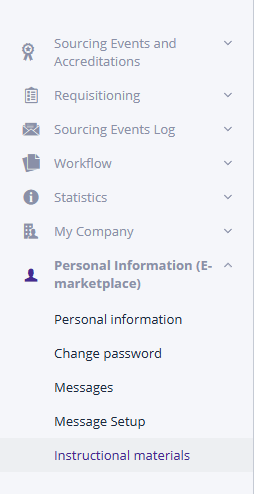
Menu items and access to system sections are configured based on the roles assigned to the user within their company. If additional section access is required, the user should contact the company’s "employee administrator."